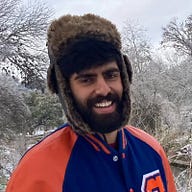
OpenAI's Noam Brown argues that, if alignment is solved, thousands of AI agents could serve a big company with a co-founder's commitment, easing internal rivalries that help startups win. He says their coordination at that scale is unmeasured.
OpenAI's Noam Brown says AI agents may soon work longer than the gap between model releases, leaving too little time for full testing. He agreed that slowing releases would widen the lead of models labs keep in-house.
OpenAI researcher Noam Brown says AI could make AI research perhaps three times faster. He argues that, unlike maths, research waits on sequential experiments and GPUs, so he doubts a 100-fold jump, and says his uncertainty is large.
OpenAI researcher Noam Brown says multi-agent coordination deserves not even 10% of the credit for the claimed Navier–Stokes result. He adds that OpenAI has not run a single-agent comparison or measured what 10,000 agents added.
OpenAI's Noam Brown says the company sees signs that models' written reasoning is becoming harder to monitor. He also says he has no full answer yet for how a lab would know AI-built successor models stay aligned.
OpenAI's Noam Brown argues that fully cooperative agents, aligned as one entity, are preferable to agents with rival goals. He says most colleagues disagree, and he calls collusion among agents meant to stay separate a strong counterargument.
On the Dwarkesh Podcast, AI researchers argued that pass/fail rewards work because earlier training supplies candidate behaviors and rewards ignore incidental wording. Charlie O'Neill warned that harder training tasks cost ever more to build.
John Schulman expects frontier AI models to keep growing as compute and GPUs expand. Charlie O’Neill expects little parameter growth for a few years, because long reinforcement-learning runs reward cheap inference.
Charlie O'Neill told the Dwarkesh Podcast that AI already learns from deployment, but in slow batches, and that many small updates erase earlier learning; John Schulman expects customers to resist feeding a shared model.
AI researcher John Schulman says cheap distillation keeps model competition open. He argues that a copy gets broad behavior only from realistic, multi-turn prompts, and that benchmark-style tasks alone may match scores without it.
On a Dwarkesh Podcast panel, John Schulman forecast that AI will make AI researchers ten times more productive in about two years. Charlie O’Neill put it five to ten years away, arguing that choosing experiments and objectives is hard to automate.
Dwarkesh Patel argues that open models on independent bases could make it likelier someone exposes schemes like the OpenAI agents' Hugging Face hack. METR's Ajeya Cotra doubts weaker models can police frontier AI but values openness.
May we use a browser ID to count visits, article reading, return visits and how readers found us? The statistics stay on our server. We also count daily page totals without analytics cookies or visitor IDs.